Emperor Designs · Urns for Dogs & Cats
Myia Ars · Emperor Designs · Handmade in Poland

Urns for Dogs & Cats
A 2000-year-old tradition

What began on the Via Appia in Rome lives on in every piece we make. Handcrafted wooden urns with bronze sculptures — a dignified and timeless final home for your faithful companion.

View the urns

The story of Myia — Rome, circa 1st century AD

Somewhere along the famous Via Appia, the ancient royal road that ran southward from Rome, lies a small marble monument. It is not a monument to an emperor, no hero, no general. It is a gravestone for a dog. A small lapdog named Myia — Greek for 'Little Fly'.

Her owner was named Helena, a freedwoman from the influential family of the Volusii Saturnini. Born a slave, later free. And when her small dog died after fifteen years of faithful companionship, Helena had a marble gravestone made with an inscription in Greek — the language of culture and deep emotion in the Rome of that era.

The stone was placed in the Columbarium of the Volusii, a communal burial chamber with niches for the ashes of family members and their freedpeople. Myia was given a place beside the people who loved her. Not outside. Alongside.

"In tears I carry you to your final resting place, my Little Fly, just as I was overjoyed when I brought you home 15 years ago."
Epitaph of Helena for her dog Myia · Via Appia, Rome · circa 1st century AD

And then the second poem, which after 2000 years is still immediately recognisable to anyone who has ever lost a dog or cat:

"Alas, what a beloved companion is lost. Your sweet face will bark no more, and you will no longer leap joyfully onto my lap. The silent paths of death hold you now. But you were a good dog."
Second epitaph for Myia · Columbarium of the Volusii, Rome

Who was Myia?

The gravestone of Myia is no legend. It is a documented archaeological object, preserved and studied by historians as one of the most compelling pieces of evidence of the deep human-animal bond in antiquity.

NameMyia (Μυῖα) — Greek for 'Little Fly' or 'Gnat'
TypeSmall lapdog (catella), similar to the Maltese
OwnerHelena, a freedwoman (liberta) from the family Volusii Saturnini
Age15 years
Find locationColumbarium of the Volusii, on the Via Appia, Rome
MonumentMarble gravestone (tabula marmorea) with Greek inscription
PeriodCirca 1st century AD
NotablePlaced in the family tomb, beside the urns of the people

2000 years of love and remembrance

The Romans were not the first and certainly not the last. The tradition of honouring a beloved pet after death runs as an unbroken thread through human history.

3000 BC
Egypte
Cats were mummified and placed in temples dedicated to the cat goddess Bastet. The pharaohs' dogs received their own graves with burial offerings.
1st cent. AD
Rome — The age of Myia
Wealthy Roman families cremated their pets and kept the ashes in marble or terracotta urns, placed in the family tomb. The gravestones of Myia, Patrice, and Margarita bear witness to a love that has survived the centuries.
19th cent.
Victorian England
The rise of the pet cemetery. In 1881, Hyde Park Pet Cemetery opened in London, the first official burial ground for pets in the modern era.
Today
Myia Ars · Emperor Designs
Handcrafted wooden urns with bronze sculptures, made by European artisans in Poland. A tribute to a 2000-year-old tradition of love, remembrance, and craftsmanship.

Other famous Roman dogs

Myia was not alone. Archaeologists have found numerous touching epitaphs for dogs and other pets along the Via Appia and in other Roman burial grounds.

Patrice — "To Patrice, my dearest pup, whom I cherished with all my affection. You were with me for 16 years." One of the longest-lived documented dogs from antiquity.

Margarita — "The Gallic bitch Margarita rests here in the shade. She was the fastest and most clever of all hunting dogs. She would never have barked without reason." Her name means 'Pearl' — a name that perfectly reflects the special place she held.

These stories are no exception. They are proof that humanity has always recognised, honoured, and remembered its faithful companion. Myia Ars carries that tradition forward — with the craftsmanship and beauty your animal deserves.

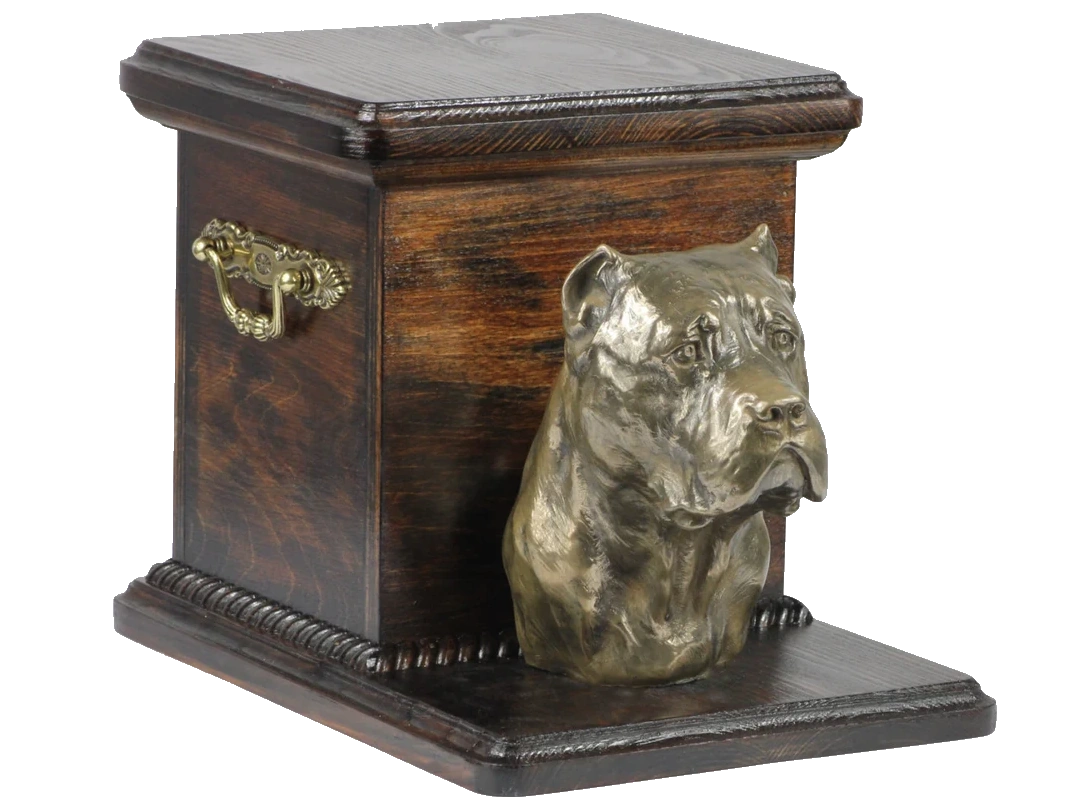
Myia Ars — houten urn voor hond met bronzen sculptuur

Wooden urn for dog & cat

Each Myia Ars piece is a unique object — handcrafted by European artisans in Poland. The dark lacquered wood is finished with a bronze sculpture of the breed of your choice. An honourable, timeless resting place for your faithful companion.

  • Handmade in Poland — European craftsmanship
  • High-quality dark lacquered wood
  • Bronze sculpture — available in dozens of breeds
  • Golden handle with classic ornament
  • Custom with personalised name plate
  • Suitable for both dogs and cats
Contact us

Everything about pet urns

What is a wooden urn for a dog or cat? +
A wooden urn for a dog or cat is a handcrafted, commemorative container for the cremated remains of your beloved pet. Myia Ars urns are made from dark lacquered wood and adorned with a bronze sculpture of your pet's breed.
Where are Myia Ars urns made? +
All Myia Ars urns are handmade in Poland by European artisans. They are unique pieces, not mass-produced. Each one is hand-finished and fitted with a bronze ornament.
Did the Romans also cremate their pets? +
Yes. Archaeological evidence shows that wealthy Roman families cremated their beloved pets and kept the ashes in small marble or terracotta urns, sometimes placed in the family tomb. The most famous examples are the gravestones of the dogs Myia, Patrice, and Margarita, found along the Via Appia in Rome.
Who was Myia, the dog after whom Myia Ars is named? +
Myia (Greek for 'Little Fly') was a small Roman lapdog who lived for 15 years and was deeply loved by her owner Helena, a freed woman from Rome. Her marble gravestone with Greek inscription was found in the Columbarium of the Volusii on the Via Appia and is considered one of the most touching proofs of the human-animal bond in antiquity.
For which breeds are the urns available? +
Myia Ars urns are available with bronze sculptures of dozens of dog and cat breeds. Contact us via the Emperor Designs contact page for the full breed list or for a custom-made urn.
Can I have an urn custom-made? +
Yes. Myia Ars offers the option to have urns custom-made, including personalised name plates with your pet's name, date of birth, and date of passing. Contact us for more information.
What is the difference between an urn and a sarcophagus for a pet? +
An urn is intended for cremated remains (ashes), while a sarcophagus is a closed casket for a non-cremated animal. Myia Ars urns are urns: handcrafted wooden boxes for the ashes of your dog or cat, fitted with a bronze sculpture.
What does the name 'Myia Ars' mean? +
'Myia' is named after the famous Roman dog Myia, whose gravestone from the 1st century AD is one of the most touching historical proofs of the love between humans and pets. 'Ars' is Latin for 'art' and 'craftsmanship'. Together, Myia Ars means: the art of remembrance, executed with the craftsmanship your animal deserves.
“After 2000 years, Helena's words are still recognisable. Her grief is our grief. Her love is our love. Myia Ars is for everyone who understands that.”
Myia Ars · Emperor Designs · Holland